
Content Ops Director
Direct, check and improve content ops at the speed of AI
Keep up with the pace of change with a control overlay over your Content Operations. Human-approved standards, quality gating and a durable record, so your operation keeps up without dropping the bar.
The challenge
AI is stressing every part of the system
Product development and operational expectations are accelerating, but your technical content operations can’t if governance still relies on humans reading everything.
You need a step-change in throughput and in how content is created. But you can’t sacrifice robust governance; liability and regulatory expectations don’t disappear when the agents arrive.
A control overlay gives you oversight, enforces your standards and can scale at the rate of AI adoption.
Your control overlay
A control overlay for technical content operations
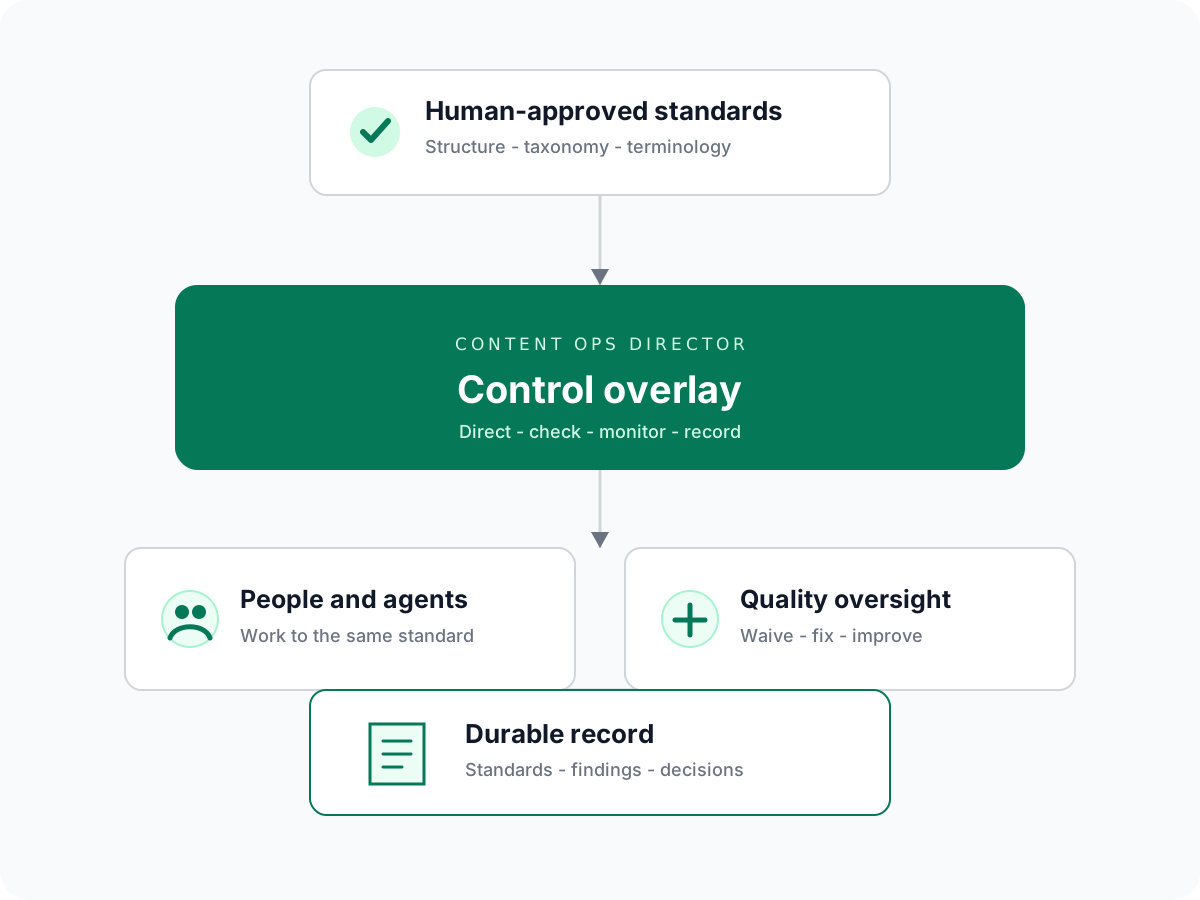
Content Ops Director is where you capture your content standards, where authors and agents get those standards, and where you monitor your operations.
Information Architects
Define and approve the standards to be used across the content
Content Developers
People and agents work to those standards
Quality Team
Monitor what is built, and decide what to waive, fix, or improve
Compliance Team
Get a durable record of content production
What you get
Keep control when AI scales the operation
Centralised, versioned standards, approved by humans.
Define document structure, taxonomy and terminology to be used by authors. Share them as human or machine-readable formats to ensure consistency across products.
Oversight of what agents are producing.
Track production, which design assets are used, and at what cost. Dashboards and reports show whether operations remain within guidelines, including cost control.
Provide a quality gate for published content.
Standardised, automated checks for all published content run against your standards. Your team reviews the findings and decides to waive or fix any issues.
Standards are versioned, builds are captured, and QA runs recorded.
Record the version of your design assets used for each agent build, and each QA run to provide an immutable record.
A control overlay for your existing tools.
Leverage the systems you already use for standards, such as terminology and taxonomies. Integrate with existing CI and automation environments. Share records with your quality systems.
Monitor the performance of agents, published content and your standards over time.
Compare build reports and AI assistant reports to identify opportunities to improve each step of your content operations.
Who it’s for
Situations we’re built for
You’ve multiplied your output and review is now the bottleneck
Production scaled; assurance didn’t.
Your documentation feeds an AI assistant and you can’t see what it’s getting wrong
Bad answers arrive as anecdotes.
Agents are writing your documentation now
Drafts outrun anyone who could check them.
You author in DITA or S1000D and nothing checks what actually ships
Schema validity isn’t conformance.
You have to evidence information quality for a regulated product
Auditors want how you know, not that it’s “good.”
You finished a structured-content migration and can’t prove it worked
Builds succeed; conformance is unknown.
Next step